Labs
Topologies from the Cisco Modeling Labs bench.
Each card is the topology from the Cisco Modeling Labs bench, with an automated grader on
the other side. Diagrams and intent are public. Passwords, answer keys, and planted-fault
lists are not.
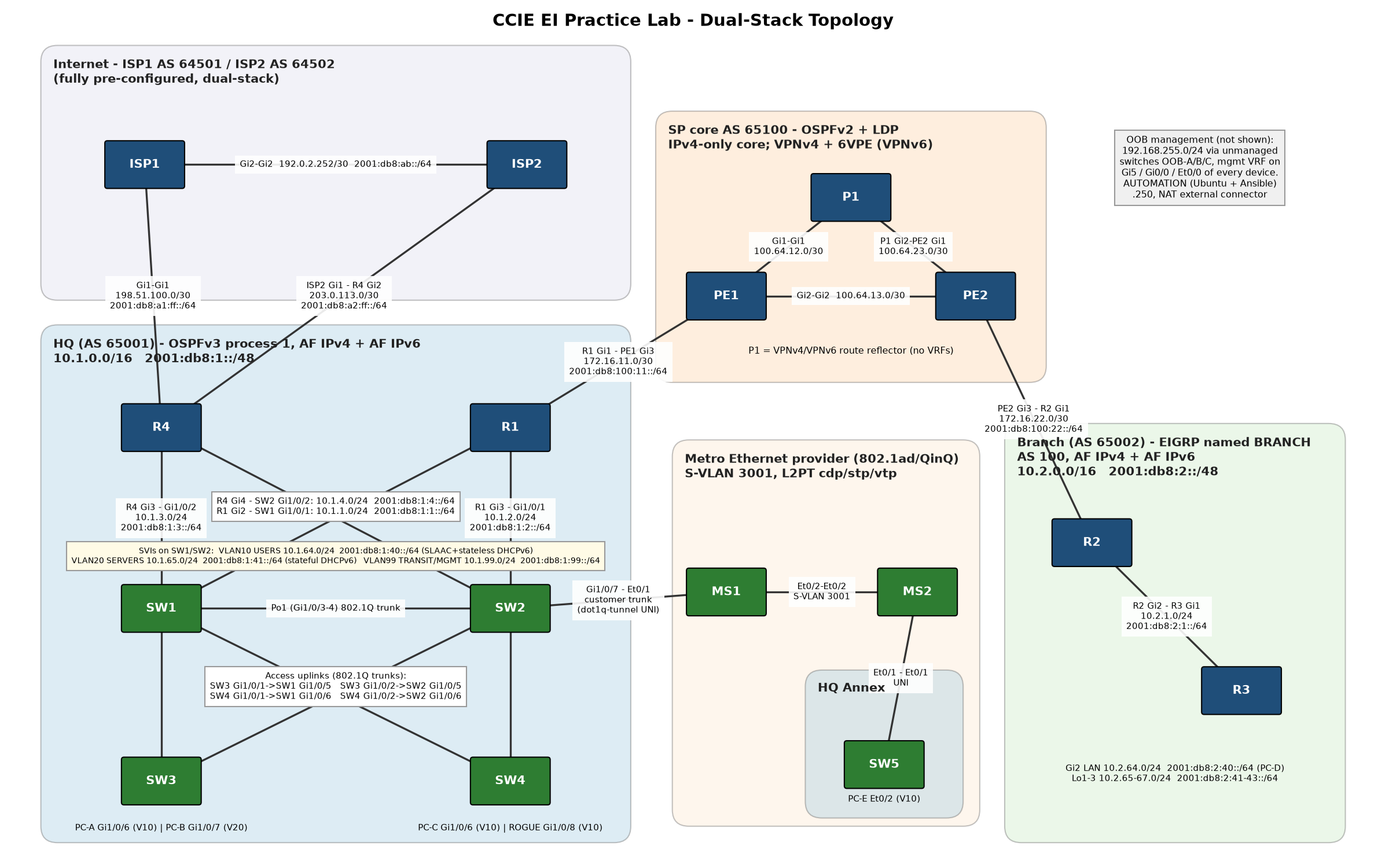
Dual-stack practice lab: ISP1 (AS 64501) and ISP2 (AS 64502), an OSPFv3 headquarters (AS 65001) with R1, R4 and SW1–SW4, an MPLS core (AS 65100) of P1, PE1 and PE2, a metro Ethernet handoff to the HQ annex, and an EIGRP named-mode branch (AS 65002) on R2 and R3.
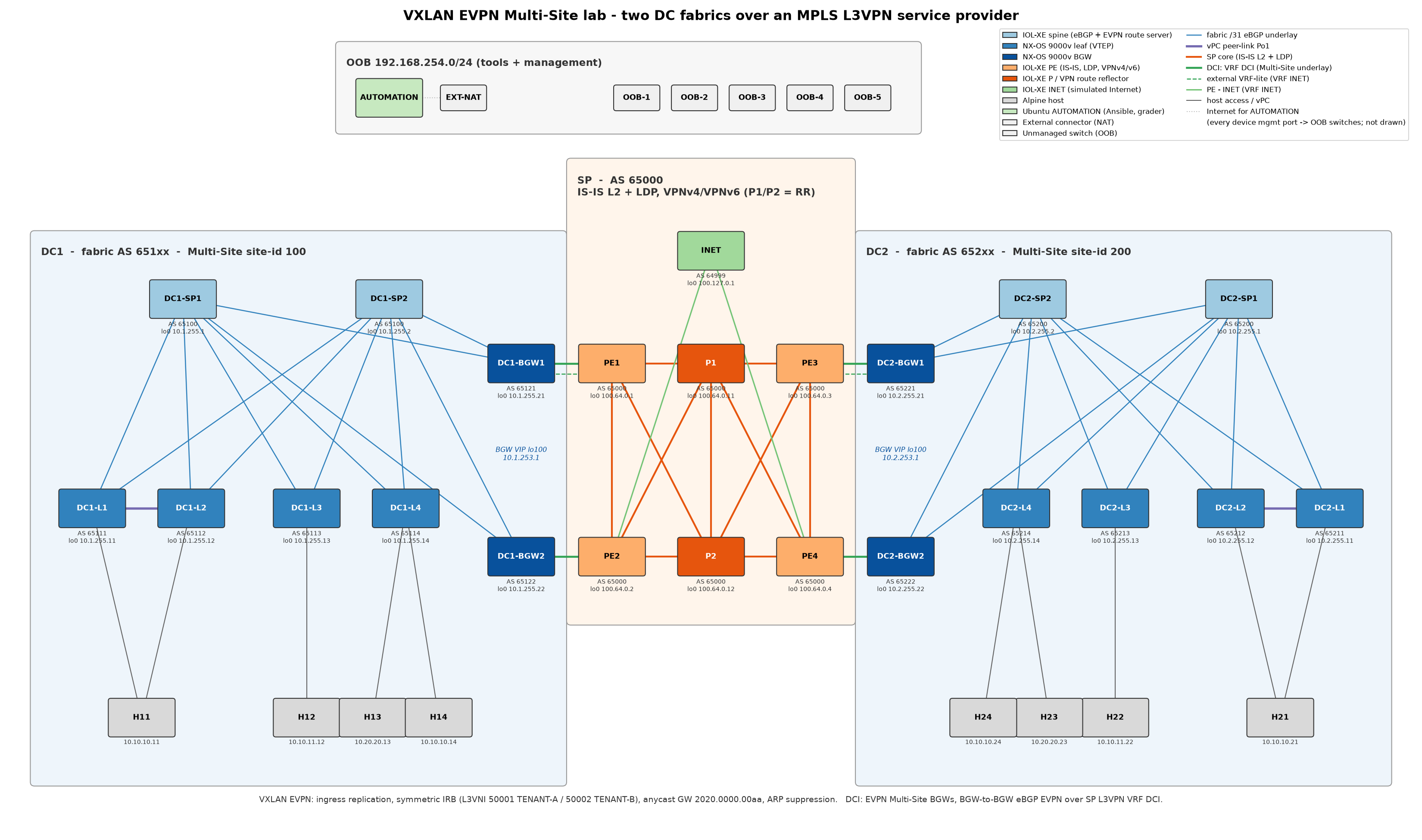
Two VXLAN fabrics, DC1 (site-id 100) and DC2 (site-id 200), tied together by border gateways that speak eBGP EVPN across an MPLS L3VPN provider. Each fabric has two spines, four leaves, and a pair of border gateways.
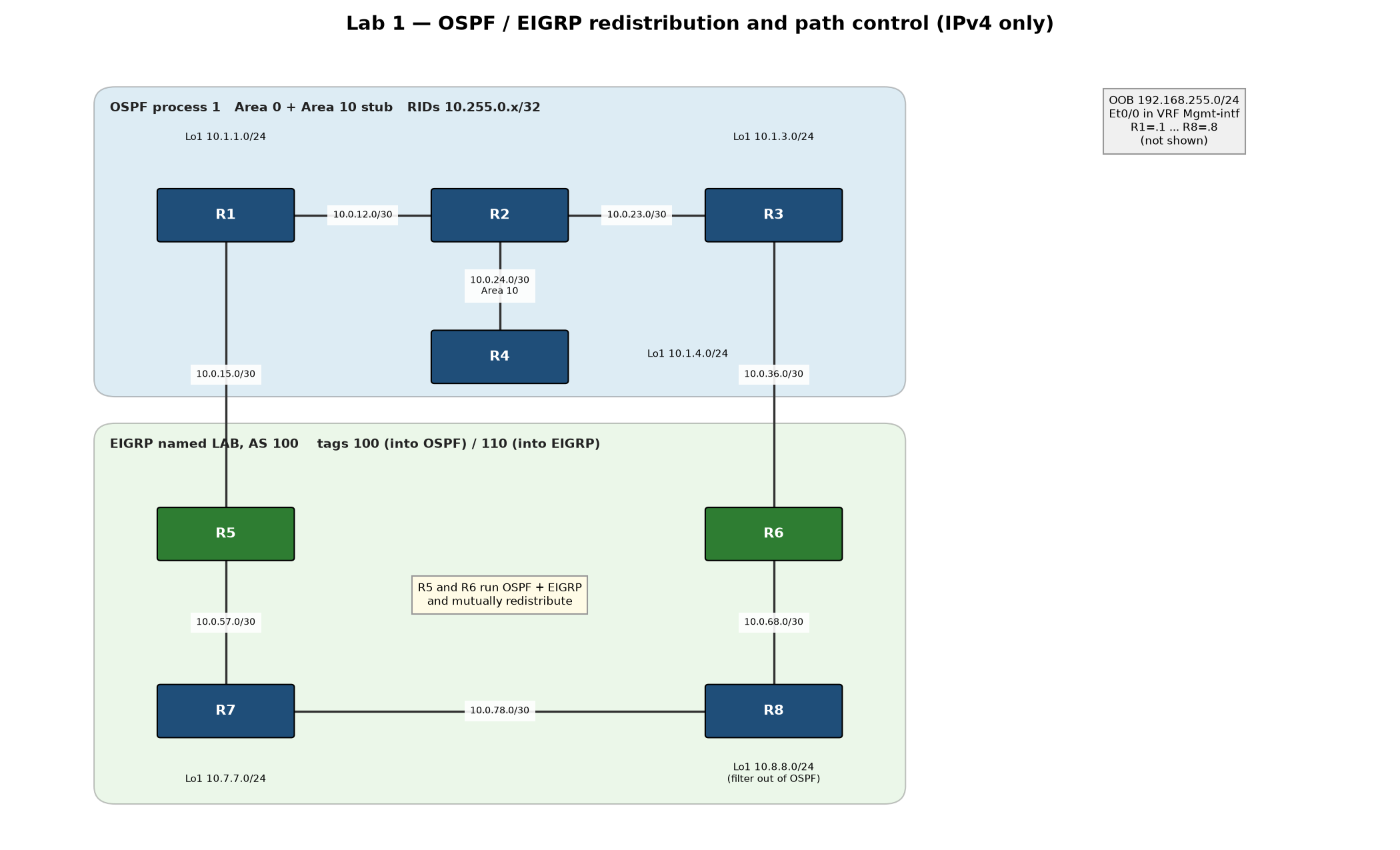
IPv4 only. OSPF process 1, area 0 plus a stub area 10, on R1 through R4. EIGRP named mode, AS 100, on R5 through R8. R5 and R6 run both protocols and redistribute both ways, with tags 100 into OSPF and 110 into EIGRP.
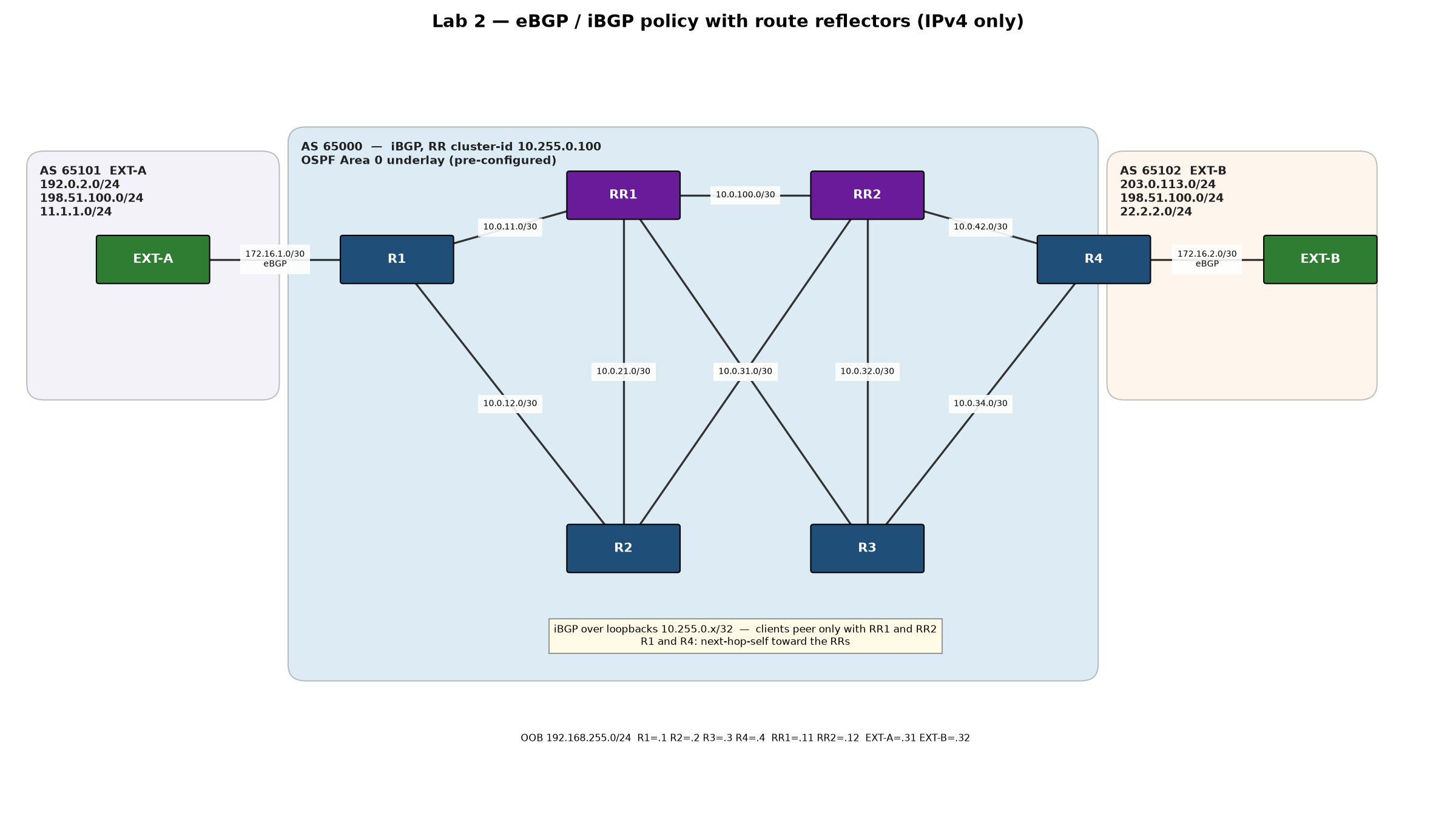
IPv4 only. AS 65000 runs iBGP over loopbacks, with RR1 and RR2 in cluster 10.255.0.100. R1 through R4 are clients and peer only with the two reflectors. EXT-A (AS 65101) is eBGP on R1, and EXT-B (AS 65102) is eBGP on R4.
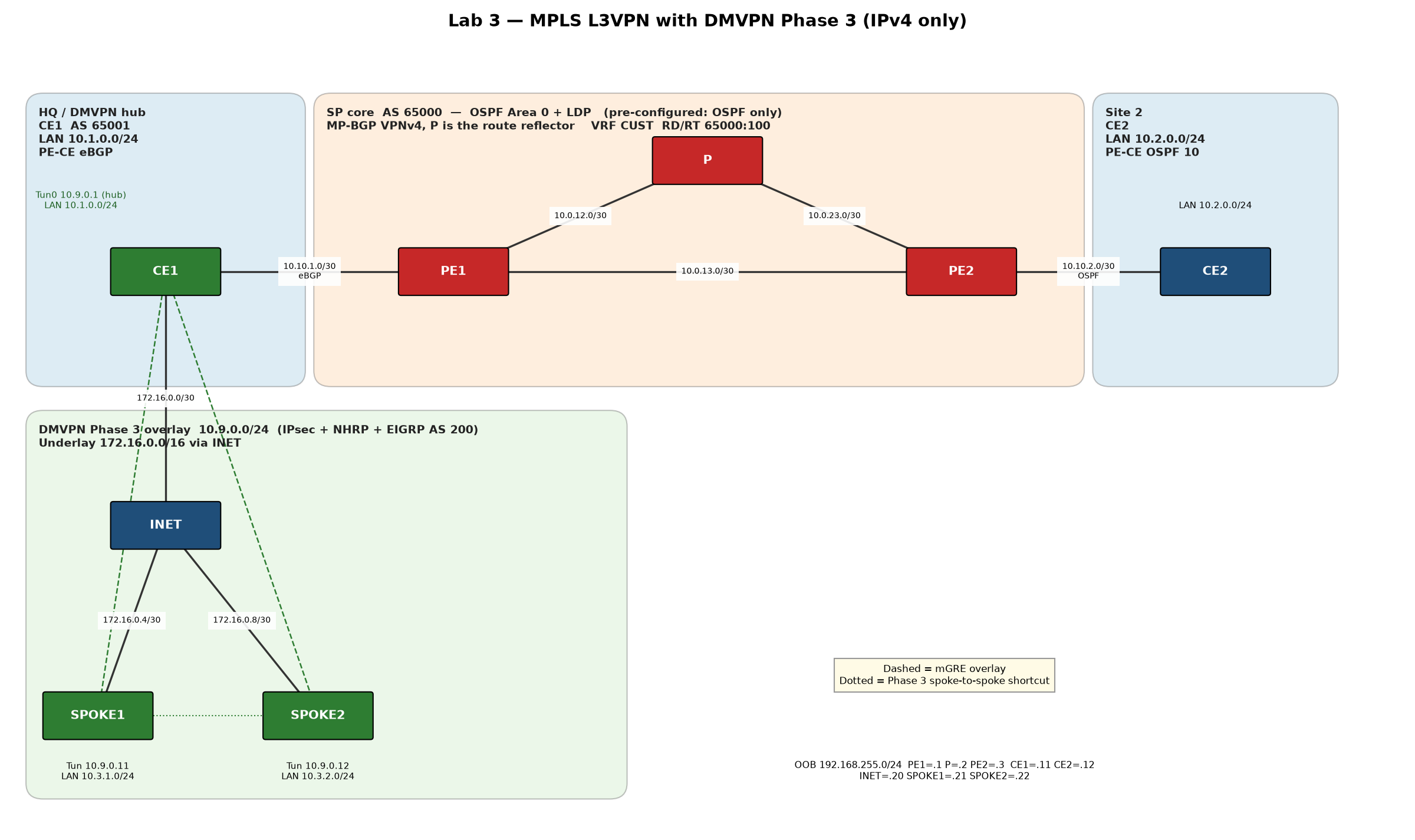
IPv4 only. CE1 (AS 65001) is the DMVPN hub and peers eBGP to PE1. The provider core is AS 65000, OSPF plus LDP, with P as the VPNv4 route reflector in VRF CUST. CE2 is OSPF PE-CE at the far site. Spokes ride a Phase 3 overlay through INET.
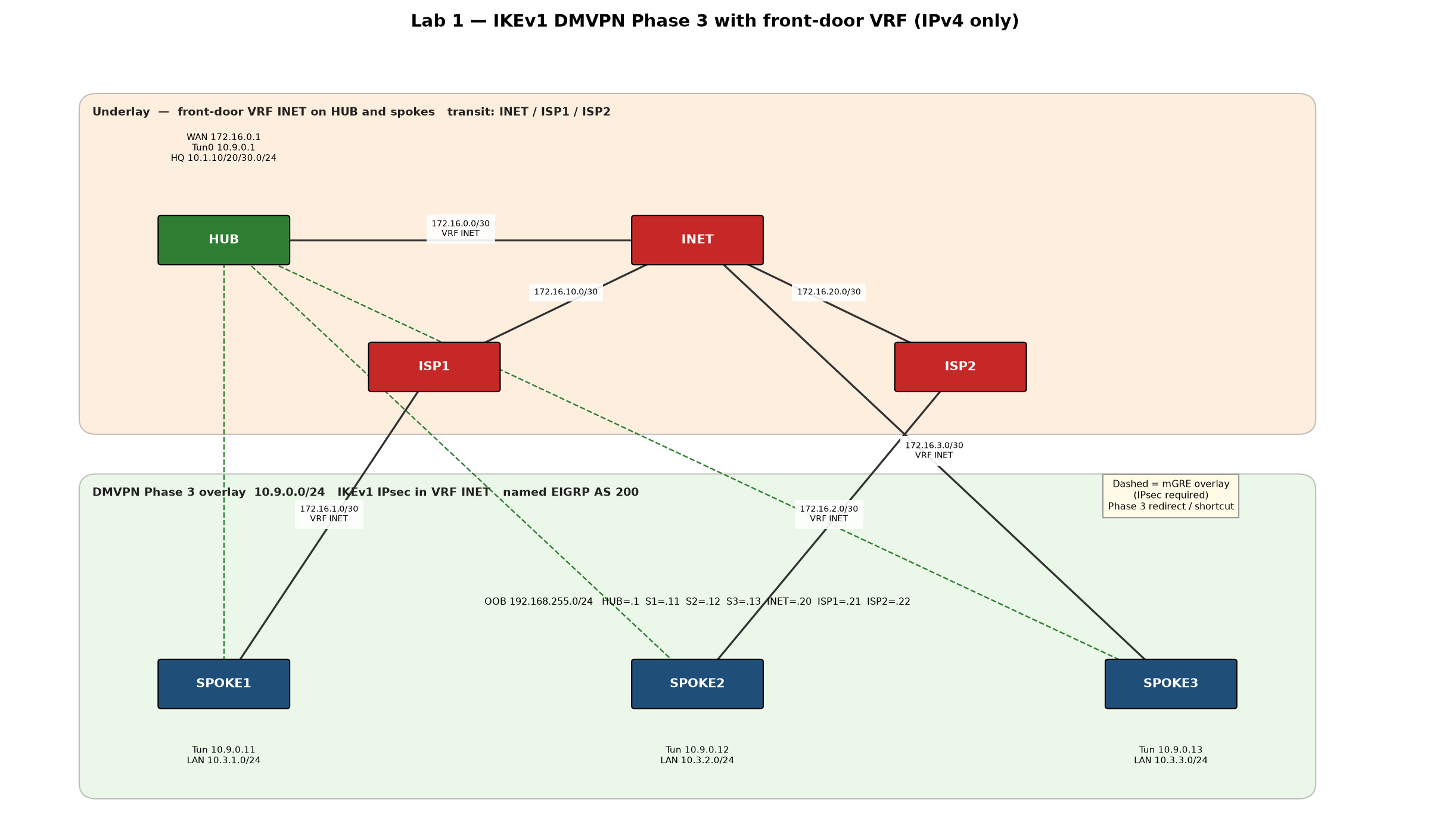
IPv4 only. Phase 3 DMVPN with IKEv1. The front-door VRF INET holds the underlay on the hub and the spokes. Transit is INET, ISP1, and ISP2. The overlay is 10.9.0.0/24 in VRF INET, protected with IPsec, and routed with named EIGRP AS 200.
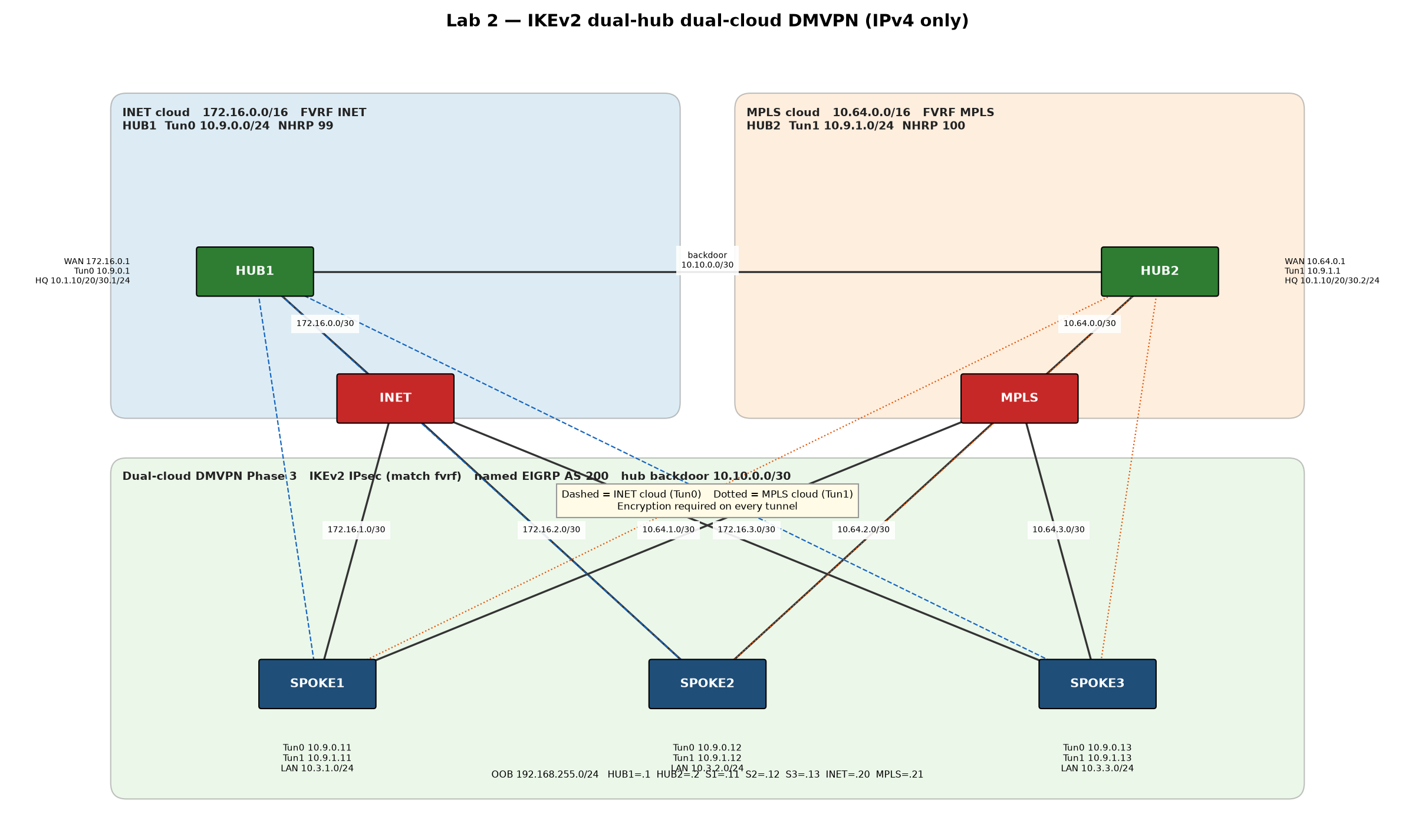
IPv4 only. Two clouds and two hubs. HUB1 anchors the INET cloud (FVRF INET, Tunnel0, NHRP 99). HUB2 anchors the MPLS cloud (FVRF MPLS, Tunnel1, NHRP 100). Every spoke has a tunnel into each cloud. IKEv2 IPsec and named EIGRP AS 200 ride both.