Lab 01 · Cisco Modeling Labs
CCIE EI dual-stack enterprise
Dual-stack practice lab: ISP1 (AS 64501) and ISP2 (AS 64502), an OSPFv3 headquarters (AS 65001) with R1, R4 and SW1–SW4, an MPLS core (AS 65100) of P1, PE1 and PE2, a metro Ethernet handoff to the HQ annex, and an EIGRP named-mode branch (AS 65002) on R2 and R3.
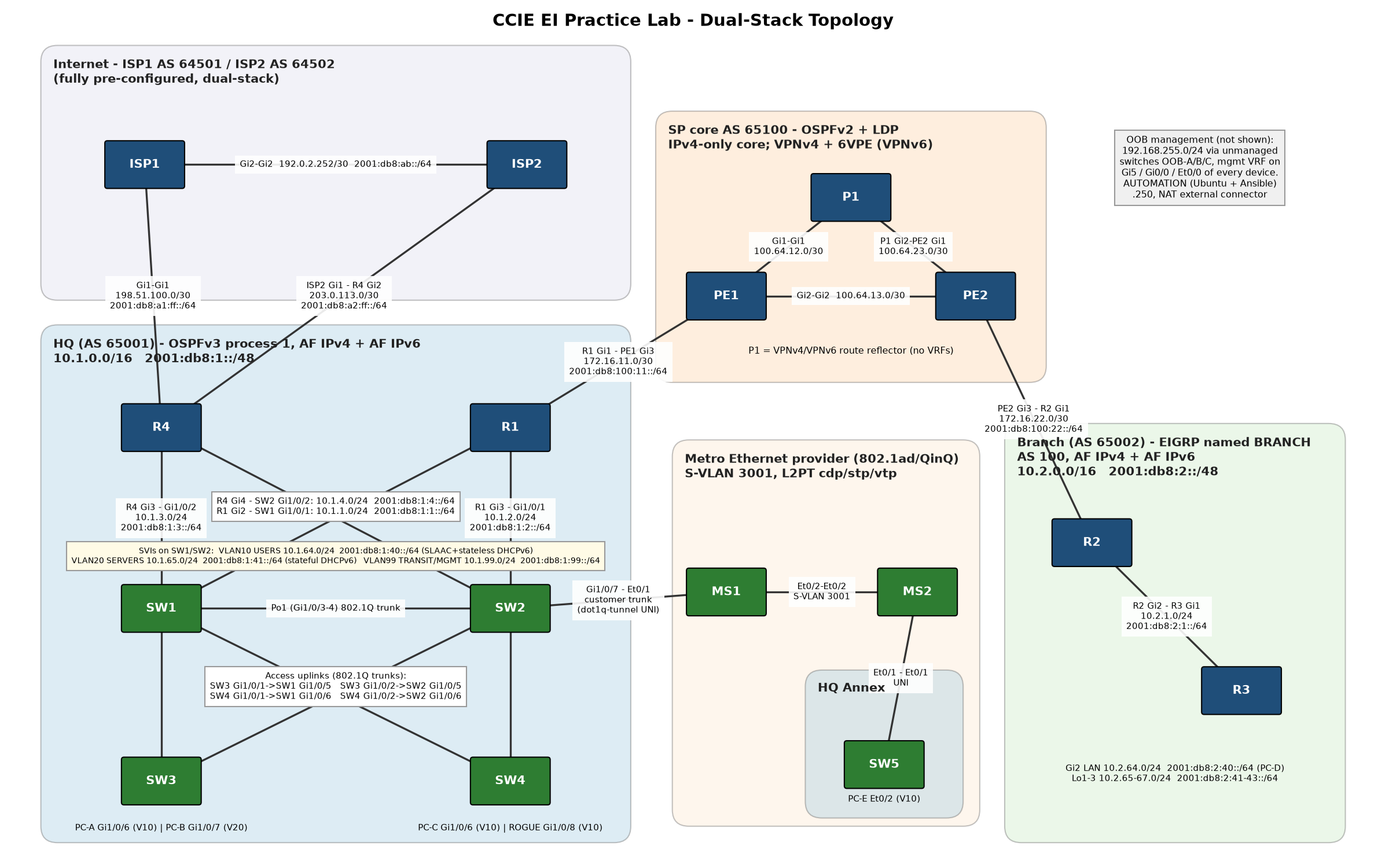
What the drawing is showing
The internet edge is pre-configured and dual-stack. Headquarters runs OSPFv3 process 1 with both the IPv4 and IPv6 address families, on 10.1.0.0/16 and 2001:db8:1::/48. R4 faces ISP1; R1 faces ISP2 and PE1. The service-provider core is IPv4-only OSPFv2 plus LDP, carrying VPNv4 and 6VPE, with P1 as the VPN route reflector and no VRFs on P1. PE2 hands the branch off to R2. The branch is AS 65002, EIGRP named mode, dual-stack on 10.2.0.0/16 and 2001:db8:2::/48, with R3 behind R2. Between the headquarters and the annex, MS1 and MS2 are a metro Ethernet provider (S-VLAN 3001, L2 protocol tunneling) in front of SW5. Built in Cisco Modeling Labs and checked with an automated grader. Passwords, answer keys, and planted faults are not published.
Covered here
- OSPFv3 v4/v6
- VPNv4 and 6VPE
- LDP
- Metro Ethernet
- Named EIGRP